Why Your Brand Needs Multiple Social Media Platforms in 2026 (Backed by Data)
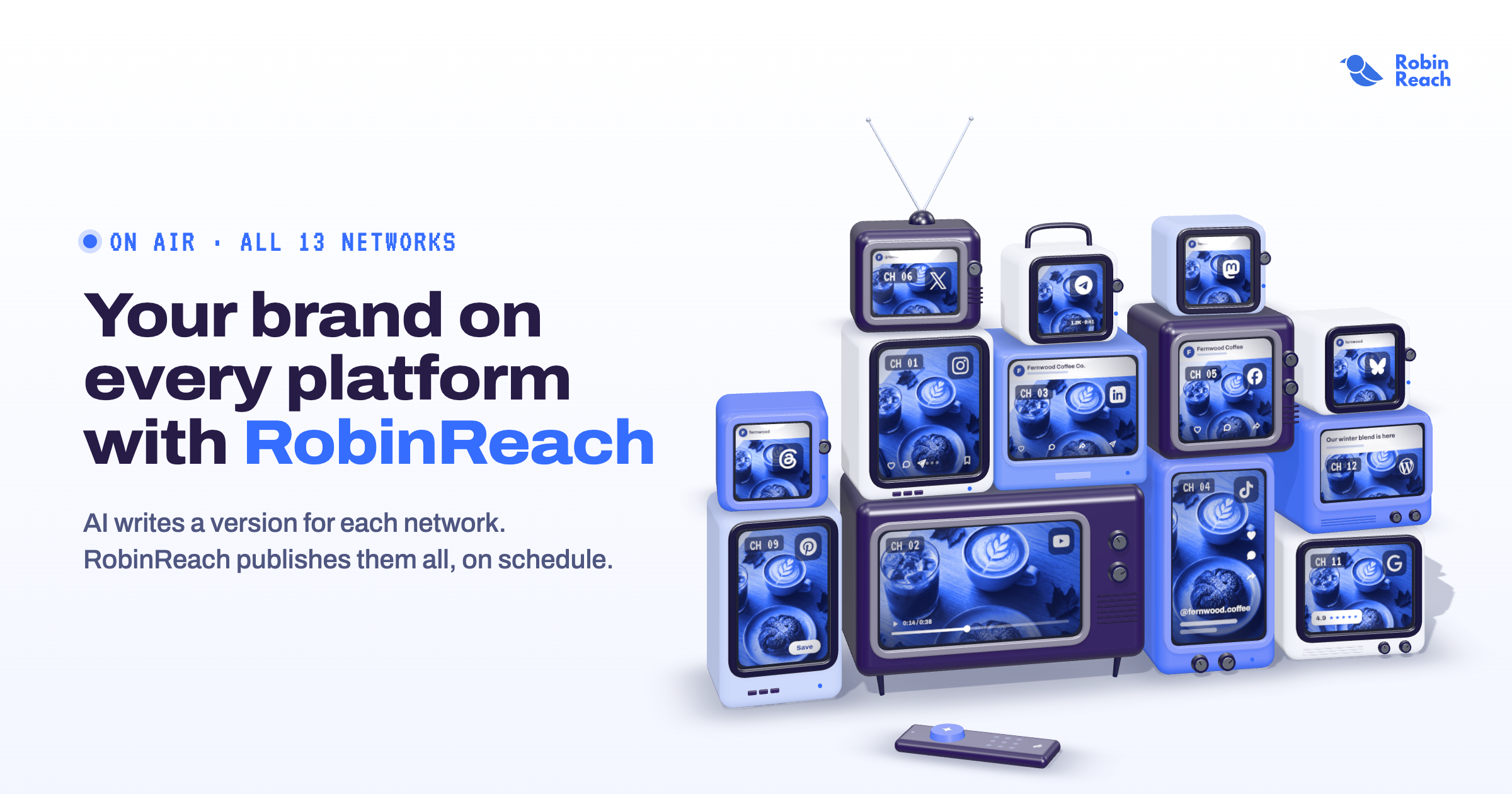
Your customers aren't on one app. They wake up on Instagram, research on YouTube, argue on Threads, check LinkedIn at work and search TikTok for "best X near me" before they ever touch Google.
The average social media user now uses 6.66 different platforms every month (DataReportal, Oct 2026). If your brand lives on one of them, you're showing up for a sliver of that person's day and invisible for the rest.
And there's a newer reason this matters. AI assistants like ChatGPT, Claude, Gemini and Perplexity now answer the questions people used to Google, and they pull a big share of those answers from social platforms. Each one pulls from different platforms. So being everywhere isn't just about reach anymore. It's about being the answer.
This guide covers the numbers behind a multi-platform presence, what each channel is actually good for, and how we built RobinReach so a small team (or one person with an AI assistant) can run 13 platforms without losing their mind.
The numbers: your audience is already multi-platform
Here's where things stand at the end of 2026, mostly from DataReportal's latest global data:
- 5.81 billion social media user identities worldwide as of October 2026, close to 7 in 10 people on Earth.
- 94.5% of internet users use social media every month.
- 6.66 platforms used per person, per month, on average.
- 19 hours 18 minutes a week spent on social media. That's more than a full waking day.
- 16 billion hours a day spent on social platforms, worldwide.
Even the biggest network on the planet misses more than 4 in 10 internet users every month. Your audience is spread out, so your brand has to be too.
It's the same story for local businesses. BrightLocal's 2026 research found that 75% of consumers use more than one channel during a local business search, and 45% now use ChatGPT or other AI tools to get local recommendations.
People also use each platform for something different. DataReportal notes that TikTok users mostly come for entertainment, Instagram and Snapchat users like to post their own content, and Pinterest users are unusually likely to research brands. Same person, different mindset, depending on which app is open.
Sources: DataReportal Global Social Media Statistics, BrightLocal Local SEO Statistics 2026
5 reasons to be on multiple social platforms
1. AI search pulls its answers from social, and every AI pulls from different places
This is the big one for 2026.
Meltwater analyzed 9.5 million AI citations and found that LinkedIn, Reddit and YouTube make up 47.5% of what AI models cite, versus 18.7% for company websites. LinkedIn alone was the #2 most cited source, right behind YouTube (Meltwater, May 2026).
Goodie tracked 1.86 million social citations across 10 AI tools and found something even more useful (Goodie, Sep 2026):
- Social content now supplies nearly 3x more evidence to AI answers than brands' own websites.
- No two AI models cite the same social platforms in the same mix. ChatGPT leaned heavily on Reddit, Claude shifted toward TikTok, Perplexity leaned into LinkedIn, and Gemini runs on YouTube and Reddit and started adding Facebook.
- The models changed which platforms they cite 16 times in 7 months, with zero warning.
So if you're only on one platform, you're betting that every AI assistant will keep citing that one platform. The data says they won't. Being present across channels is how you stay in the answer no matter which assistant your customer uses this month.
2. Each platform reaches a different slice of your market
B2B buyers are on LinkedIn. Younger shoppers discover on TikTok and Instagram. Local customers check your Google Business Profile before they visit. Tech and open web communities hang out on Bluesky and Mastodon. One channel can't cover all of them.
3. Algorithm and platform risk
Platforms change their rules overnight. Reach drops, accounts get restricted, whole apps get threatened with bans. If 100% of your audience lives on one platform, one policy change can wipe out years of work. Spreading out is basic risk management.
4. Trust and search visibility
When someone Googles your brand, active profiles on several networks fill the first page and signal that you're real and current. A dead profile or a missing one does the opposite.
5. More shots at going big
The same post can flop on X and take off on Threads. Posting across channels gives every piece of content more chances to find its audience, at almost no extra cost if your workflow is right.
Why RobinReach supports 13 platforms (and what each one is for)
We didn't add platforms to pad a feature list. Each one reaches people the others don't. Here's how we think about them:
- Facebook. Still the biggest. Facebook ads reach 2.32 billion people, and it's where 43% of small businesses keep an active presence. Great for communities, local businesses, events and older audiences.
- Instagram. Ad reach of 1.96 billion. Visual discovery, Reels and carousels, and a review site in disguise: 37% of US consumers use Instagram to check out local businesses.
- TikTok. Ad reach of 2.33 billion. Short video, discovery and search for younger users. 29% of US consumers use it for local business reviews, and it's the fastest moving social source in AI answers.
- YouTube. The largest ad reach of any social platform at 2.77 billion, and the most cited social source in AI answers. Long form for depth, Shorts for reach.
- LinkedIn. 1.55 billion members and the #2 most cited source in AI answers overall. If you sell to businesses, this one isn't optional.
- X. Real time conversation for news, tech, finance and politics. Smaller than it was, but still where a lot of industry chatter breaks first.
- Threads. Hit 500 million monthly users in June 2026 and passed X in daily mobile users earlier in the year. Reach is still easier to earn here than on older networks.
- Bluesky. Smaller and quieter after its 2024 boom, but packed with writers, journalists, academics and tech people who actually engage.
- Mastodon. The decentralized network. Niche, loyal communities that reward genuine posting over polish.
- Pinterest. 661 million monthly users and 80 billion searches a month, more than half with commercial intent. People come here to plan and buy.
- Google Business Profile. 52% of consumers start their local search on Google, and Google says a complete profile makes people 2.7x more likely to see you as reputable. Yet only 35% of small businesses actively maintain theirs.
- Telegram. Over 1 billion monthly users. Channels deliver straight to your audience with no algorithm in the way.
- WordPress. Runs roughly 4 in 10 websites. Your own blog is owned content you control, and it feeds both search engines and AI crawlers.
You don't need to go all in on all 13 from day one. But you should be able to, from one place, the moment it makes sense for your brand.
Sources: DataReportal (ad reach), Meltwater, Goodie, BrightLocal, TechCrunch on Threads, Pinterest Q3 2026 results, Pinterest Q3 2026 earnings call, Telegram, W3Techs via Search Engine Journal
The real problem: 13 platforms is a lot of work
Nobody argues with the idea of being everywhere. The problem is doing it.
Every platform has its own character limits, image ratios, video rules and posting quirks. Instagram wants 4:5. LinkedIn wants a different tone. X cuts you off at 280 characters. Then there are 13 inboxes of comments to answer and 13 sets of analytics to check.
Small business owners feel this the most. BrightLocal's 2026 Small Business Marketing Report found 85% of owners handle marketing decisions alone. When asked what stops them doing more, 28% said it's too technical and 23% said they simply don't have the time.
Done by hand, that's a full time job. So most brands either burn out or quietly let half their profiles go dead. A dead profile is worse than no profile, because it tells people you stopped caring.
The fix isn't working harder. It's one place to plan, post, reply and measure, with AI doing the repetitive parts.
How Claude and ChatGPT make it effortless with RobinReach MCP
This is where things get fun.
MCP (Model Context Protocol) is the open standard that lets AI assistants like Claude and ChatGPT use real tools. RobinReach has its own MCP server, so once you connect your account, your AI assistant can actually run your social media, not just write captions you copy and paste.
Connecting takes about a minute: add RobinReach as a connector in Claude or ChatGPT, sign in, and choose whether the assistant gets your whole account or just one brand. That last part matters for agencies. You can give an AI access to a single client brand without exposing the rest.
What you can ask for
You just talk to it. For example:
- "Turn this blog post into posts for LinkedIn, X, Threads, Bluesky and Facebook, each written for that platform, and schedule them at our best times next week."
- "Make a 7 slide carousel about our new feature for Instagram and LinkedIn."
- "What were our top 5 posts last month, and on which platforms?"
- "Show me unanswered comments and draft replies in our brand voice."
- "Add our best posts from the last 90 days to an evergreen folder that reposts every two weeks."
- "Is there any day next week with nothing scheduled?"
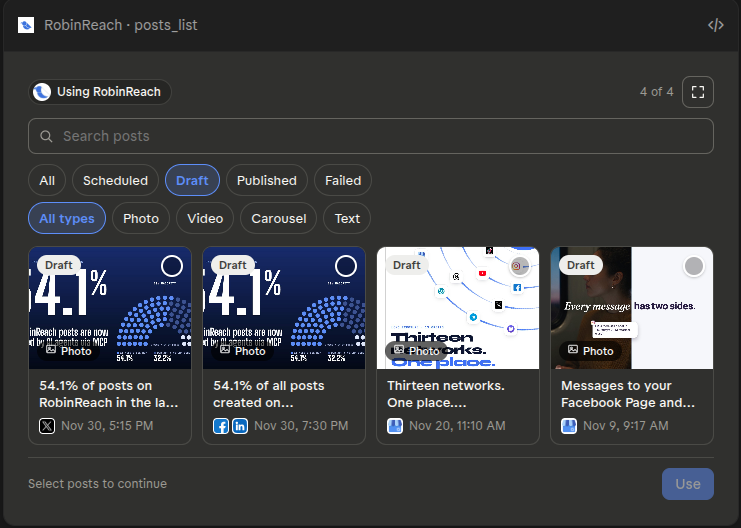
Behind the scenes, the assistant uses RobinReach tools to adapt content for each platform's limits, upload media, schedule, check analytics and manage your inbox. In Claude, many of these actions now show up as interactive widgets right in the chat, so you can see your posts instead of reading a wall of text.
What it looks like in practice
Here's a real kind of request a founder might send to Claude with RobinReach connected:
You: We just launched Evergreen Folders. Write a launch post for LinkedIn, X, Threads, Bluesky, Mastodon and Facebook, plus an Instagram carousel. Schedule everything at our best times this week.
Claude: Checks your connected profiles and best posting times, writes a version for each platform within its character limits, builds a 6 slide carousel, and shows you the drafts in a scheduling widget. Once you approve, it schedules all seven posts.
That's one message instead of an afternoon of copy, paste, resize and reschedule.
Built for agencies too
Every brand in RobinReach can have its own API key, scoped to that brand only. So an agency can hand one client's key to an AI agent or a freelancer without exposing any other client. One account, many brands, each with its own guardrails.
Why this changes the math
The old tradeoff was simple: more platforms meant more hours. With an AI assistant connected to RobinReach, adding a platform is closer to adding a word to your prompt. One idea, 13 native versions, scheduled in one conversation.
That's what we mean when we call RobinReach the social media manager for AI agents. You keep the strategy and the final say. The assistant does the busywork.
How to go multi-platform without burning out
- Claim your name everywhere today. Even if you won't post on a platform yet, grab the handle before someone else does.
- Pick 3 to 5 core channels. Choose based on where your buyers are, not where you personally like to scroll. B2B? Start with LinkedIn, YouTube and X. Local business? Google Business Profile, Facebook and Instagram.
- Write once, adapt everywhere. Start from one strong idea and let AI reshape it for each platform. Same message, native format.
- Recycle your winners. Your best posts deserve more than one run. Evergreen folders keep them working while you sleep.
- Answer comments in one inbox. Replies build trust and feed the algorithm. Don't make yourself log into 13 apps to do it.
- Expand once the system runs itself. When your core channels are on autopilot, add the next platform. It's one more connection, not one more job.
- Measure, then double down. Check which platforms actually drive clicks and conversations, and shift effort there.
FAQ
Should a business be on every social media platform?
Not on day one. Start with the 3 to 5 platforms where your customers spend time, then expand. The average user is on 6.66 platforms a month, so a single channel will always leave reach on the table.
How many social media platforms should a small business use?
Most small businesses do well with 3 to 5 active channels. With a scheduler and an AI assistant handling the adapting and posting, many can run more than that without adding hours.
Does social media help with AI search visibility?
Yes. Studies in 2026 found that social platforms like YouTube, LinkedIn and Reddit supply a large share of the sources AI assistants cite, often more than brand websites. Each AI tool favors different platforms, so a presence on several gives you more chances to be cited.
Can ChatGPT or Claude post to social media for me?
Yes, when connected to a tool built for it. With the RobinReach MCP connector, Claude and ChatGPT can create, adapt and schedule posts across your connected profiles, check analytics and help manage comments, while you approve the strategy.
Which social platforms does RobinReach support?
13: Facebook, Instagram, TikTok, YouTube, LinkedIn, X, Threads, Bluesky, Mastodon, Pinterest, Google Business Profile, Telegram and WordPress.
What is an MCP connector?
MCP (Model Context Protocol) is an open standard that lets AI assistants use outside tools. A social media MCP connector gives your assistant the ability to take real actions, like scheduling a post, instead of only writing text.
Is an inactive social media profile bad for my brand?
Usually, yes. A profile with no posts for months tells visitors you've stopped caring. If you can't keep a channel active, recycle your best evergreen posts there on a schedule, or keep only the handle reserved.
Which social platforms do AI assistants cite most?
It depends on the assistant. Across 2026 studies, YouTube, LinkedIn and Reddit were cited most overall. But ChatGPT, Claude, Gemini and Perplexity each lean on a different mix, and those mixes changed 16 times in 7 months in one study.
Be everywhere your customers are
Your audience already splits its time across almost 7 platforms, and AI assistants are now picking which brands to recommend based on what they find there. Showing up on one channel isn't a strategy anymore.
RobinReach gives you all 13 platforms in one place, and the MCP connector lets Claude or ChatGPT do the heavy lifting for you.
Start free with RobinReach and connect your first profiles in a few minutes.