AI Agents Now Create 54% of Our Social Media Posts: What Our Data Reveals About MCP
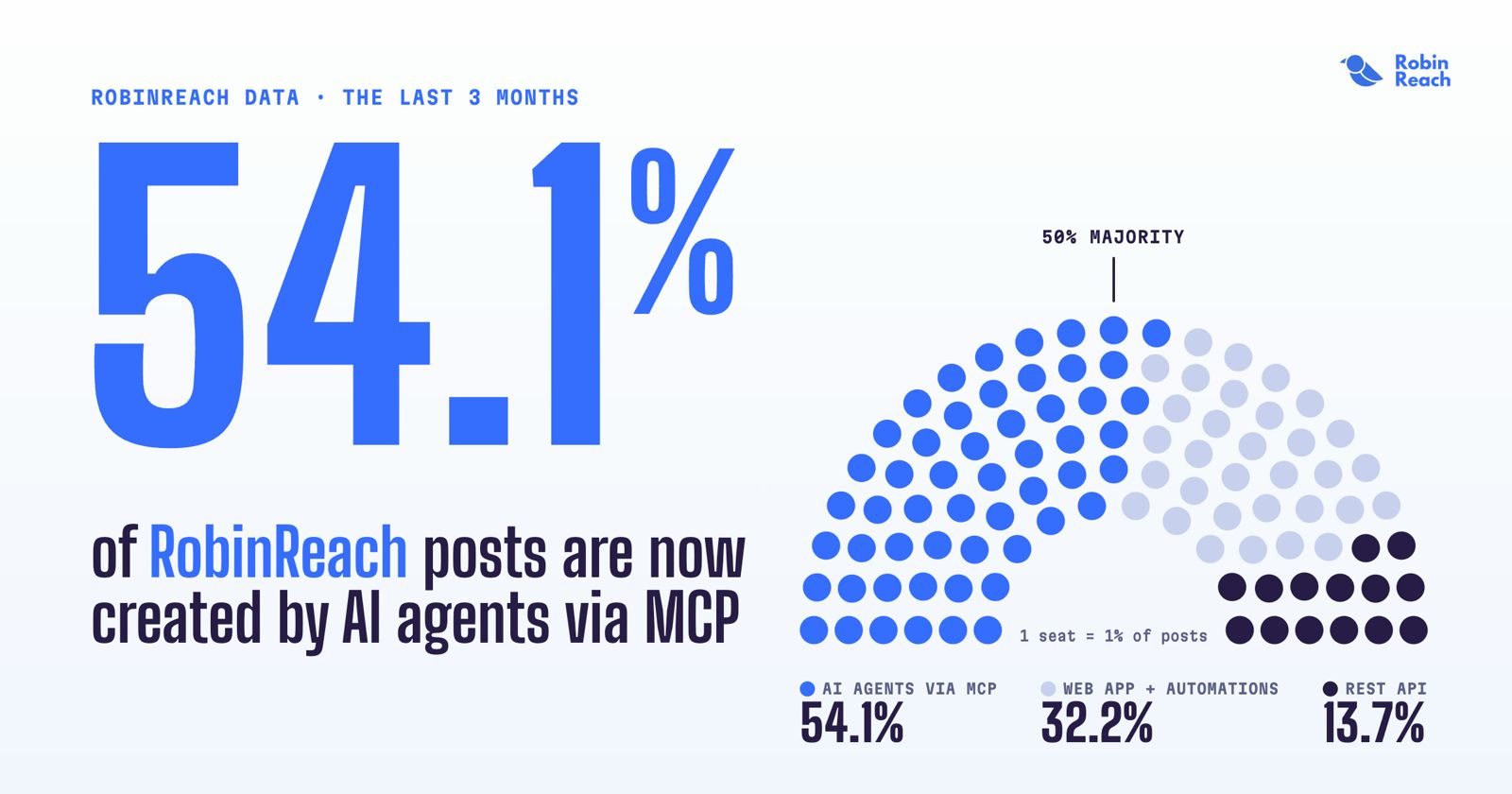
Over the last three months, 54.1% of all posts created on RobinReach came from AI agents talking to our platform through MCP, not from people clicking around our dashboard. That's more than half of everything our customers created.
RobinReach is a social media scheduling and management platform for brands and agencies. When we shipped our MCP server, we expected a few developers to experiment with it. We didn't expect it to become the main way our customers publish content. In this article, we share our data, what we think it means, and how you can use the same setup.
Key findings
- 54.1% of posts were created by AI assistants through MCP (Model Context Protocol).
- 32.2% came from our web app and built-in automations.
- 13.7% came from our REST API.
- 67.8% of all posts were created by software, not by a person using our interface.
- MCP now produces roughly 4x the post volume of our traditional API.
Why we're publishing this
There's plenty of data on whether marketers use AI. There's almost none on whether AI is actually doing the publishing.
The big surveys measure attitudes and use cases. HubSpot's 2026 Social Media Marketing Report, based on 1,100+ marketers, found that 94% of social media marketers use AI in their workflow in some way. But that tells you AI is in the room, not what it's doing.
On the MCP side, the numbers are about developers: servers built, SDKs downloaded, enterprises piloting. Digital Applied's MCP statistics review puts it plainly: there is no public count of marketing teams using MCP.
We can't fix that for the whole industry. But we can share what happens on one real platform, with real customers, posting to real social accounts. So here it is.
The data: where our posts come from
Every post in RobinReach records how it was created. We pulled every post created in the three months up to late November 2026 and grouped them by that source.
MCP: 54.1% of posts. These were created by an AI assistant, such as Claude or ChatGPT, connected to RobinReach through our MCP server. A person asks for something in plain language, and the assistant calls our tools to write, attach media, pick profiles and schedule.
Web app and automations: 32.2%. Mostly people using the RobinReach dashboard directly. This bucket also includes posts created by our built-in automations, like RSS feeds and repurposing, so the share of posts typed by hand in our composer is lower than 32%.
REST API: 13.7%. Developers and agencies with their own scripts, apps and integrations.
One detail matters for reading these numbers: a post counts once, even when it's published to several social profiles. So this measures how many pieces of content were created through each channel, not how many times they went out.
The headline isn't just that MCP is big. It's that MCP overtook both of the older channels. The REST API used to be the obvious choice for anyone automating their posting. MCP now creates about four times as many posts.
How MCP became the standard in two years
MCP (Model Context Protocol) is an open standard that lets AI assistants use outside tools and data. Think of it as a universal plug: a tool builds one MCP server, and any compatible assistant can use it.
The adoption curve explains a lot about our numbers:
- November 2024: Anthropic introduces and open-sources MCP.
- May 2025: OpenAI adds remote MCP server support to its Responses API. Microsoft announces MCP support across GitHub, Copilot Studio and Windows the same month.
- October 2025: OpenAI launches apps in ChatGPT with an Apps SDK built on MCP, opening the door to its 800M+ users.
- December 2025: Anthropic donates MCP to the Agentic AI Foundation under the Linux Foundation, with Google, Microsoft, OpenAI and AWS among its members.
- October 2026: The official MCP Registry lists 47,267 active servers, and the TypeScript SDK alone was downloaded 231.9M times from npm in September, up from 31.3M a year earlier (Digital Applied).
In other words, the assistants our customers already use every day, like Claude and ChatGPT, now speak the same language as the tools they use for work. Once that happened, the dashboard stopped being the only door into a SaaS product.
The gap: marketers use AI to write, not to publish
Here's what the industry data shows about how social media teams use AI today. In HubSpot's 2026 survey, the top AI use cases were ideation and brainstorming (42.9%), writing captions or short-form text (41.5%) and image generation (38.4%).
Notice what's missing: the actual publishing. For most teams, the workflow still looks like this. Ask ChatGPT for a caption. Copy it. Open the scheduler. Paste it. Upload the image. Pick the profiles. Pick a time. Repeat for every post, every platform, every brand.
The same report found that only 36% of social media marketers say their tool stack is very cohesive or fully integrated, and 45% say consistently producing high-quality content is their biggest challenge. That copy and paste gap is exactly where hours disappear.
MCP closes it. The assistant that writes the post can also schedule it, in the right brand, on the right profiles, at the right time. Our numbers suggest that when people are given that option, a lot of them take it.
What AI agents actually do inside RobinReach
Our MCP server isn't a thin "create post" endpoint. It exposes most of what you can do in the dashboard, so an assistant can run the whole workflow, not just one step of it. Here are the kinds of requests that come through every day.
Planning and publishing at volume
- "Turn this blog post into a week of posts for LinkedIn, X and Facebook, and schedule them at our best times."
- "Schedule these 10 clips to Instagram and TikTok, one a day starting Monday."
- "Fill the gaps in next week's calendar for all five of my client brands."
Creating, not just scheduling
- Generating carousels for LinkedIn and Instagram, previewing designs, and picking the one that fits.
- Generating images, pulling stock photos, or uploading files straight from the chat.
- Learning a brand's voice from its past posts, so drafts sound like the brand and not like a chatbot.
Running the account, not just feeding it
- Pulling analytics, top posts and best posting times based on the brand's own engagement.
- Reading and replying to comments from the inbox.
- Sending posts to a client for approval through an approval link before anything goes live.
That breadth is the point. When an assistant can only do one step, people still end up in the dashboard for the rest. When it can do the whole job, the dashboard becomes the place you check in, not the place you work.
Why agents beat dashboards for repetitive work
We build a dashboard for a living, so this wasn't the result we were rooting for. Here's why we think the shift happened so fast.
The context already lives in the chat. People research, brainstorm and draft inside their AI assistant. The brief, the blog post, the product notes are all already there. Moving that into a separate tool is pure friction.
One sentence replaces twenty clicks. Scheduling three posts by hand is fine. Scheduling sixty posts across six brands and four platforms is a chore. For an assistant, both take about the same effort from you.
Assistants connect to everything else too. The same assistant can read your Google Drive, your Notion, your store catalog, and then publish through RobinReach. No single social media dashboard can match that reach.
It works the way people think. Nobody thinks "open composer, select profiles, set date." They think "get this launch out next week everywhere we're active." MCP lets them say exactly that.
None of this makes the dashboard useless. People still come in to review the calendar, check reports and fix things visually. But the daily grind of creating and scheduling is moving to the chat.
The AI slop question: who's really in control?
This is the fair objection, so let's take it head on. If AI creates most of the posts, isn't social media about to drown in generic content?
Marketers are worried about it too. In HubSpot's survey, 77% said authenticity matters more than production value for their brand on social.
Here's what our data does and doesn't say. MCP posts aren't a bot running wild on its own. A person connects their own account, picks which brands the assistant can access, and asks for something specific. The person decides the topic, the angle, the platforms and the timing. The assistant handles the typing and the clicking.
That said, agents make it easy to post more, and more isn't automatically better. A few guardrails make a big difference:
- Teach the voice first. Have the assistant learn from your best past posts before it writes new ones.
- Save as drafts, then review. Let the agent fill the calendar, then approve what goes live.
- Use approvals for clients. Agencies can send posts to clients for sign off before publishing.
- Keep the human parts human. Opinions, stories and real experiences still need to come from you. AI is great at turning them into a week of posts, not at inventing them.
What this means for marketers and for social media tools
This is one platform's data, so treat what follows as our read on it, not a law of nature. But we'd be surprised if we were the only ones seeing it. Gartner predicts that 40% of enterprise apps will include task-specific AI agents by the end of 2026, up from less than 5% in 2025.
For marketers and agencies
- Your job moves up a level. Less time on execution, more on strategy, ideas and voice. The brief becomes the most important thing you write.
- Choose tools your assistant can use. If your scheduler has no MCP support, you're stuck copying and pasting while competitors aren't.
- Multi-brand work changes the most. Agencies managing many clients stand to save the most time, because the repetitive work grows with every brand they add.
For social media tools
- The AI agent is now a user. For us, it's the biggest one. Tools need to be designed for agents as seriously as for people.
- A full toolset beats a single endpoint. If an agent can only create posts, people still need the dashboard for everything else.
- The dashboard doesn't die, it changes job. It becomes the place to review, approve and understand performance, not the place to type.
How to connect RobinReach to Claude or ChatGPT
If you want to try this yourself, setup takes a few minutes.
- Create a RobinReach account and connect your social profiles.
- Add RobinReach as a connector in Claude or ChatGPT. Our step by step guide is here: https://robinreach.com/ai
- Sign in and choose access. You can give the assistant your whole account or just one brand. Agencies can also create a separate API key per brand, so an agent or a client only sees what they should.
- Start small. Try "Show me my scheduled posts for next week," then "Draft three LinkedIn posts from this article and save them as drafts."
- Scale up. Once you trust the output, let it plan full weeks across brands, with approvals where you need them.
It works with any MCP-compatible assistant, so you're not locked into one AI provider.
FAQ
What is MCP in social media marketing?
MCP (Model Context Protocol) is an open standard that lets AI assistants like Claude and ChatGPT use outside tools. In social media marketing, it means your assistant can create, schedule and manage posts in your social media tool directly, instead of you copying its output into a dashboard.
Can ChatGPT or Claude schedule social media posts?
Not on their own. They need to be connected to a scheduling tool that supports MCP. Once RobinReach is connected, either assistant can create and schedule posts for your connected profiles.
Which platforms can an AI agent post to through RobinReach?
The same ones you can post to from our dashboard, including Facebook, Instagram, LinkedIn, X, TikTok, YouTube, Pinterest, Threads, Bluesky, Mastodon, Google Business Profile, Telegram and WordPress.
Is it safe to let an AI assistant post for my brand?
You stay in control. You choose which brands the assistant can access, you can have it save drafts instead of publishing, and you can require approval before anything goes live. You can also disconnect it at any time.
Will AI agents replace social media managers?
We don't think so. They replace the repetitive part of the job: formatting, uploading, scheduling. Strategy, voice, community and judgment still need a person, and those are the parts that make social media work.
Methodology and how to cite this data
What we counted: every post created on RobinReach in the three months up to late November 2026, grouped by the channel that created it.
What a "post" means: one piece of content, counted once even if it was published to several social profiles.
How sources were assigned: posts created through our MCP server or REST API are tagged with that source when they are created. Posts without a source tag come from our web app and built-in automations, such as RSS feeds and repurposing.
Limits: this is data from one platform and its customers, not a survey of the whole market. A small number of high-volume accounts can influence the totals, and we did not measure how posts performed by source.
Using this data: you're welcome to quote and share these numbers. Please credit RobinReach and link back to this article, for example: RobinReach, "AI Agents Now Create 54% of Our Social Media Posts," November 2026.