The End of Social Media Dashboards: Why Marketers Are Ditching the Tools and Just Talking to Claude
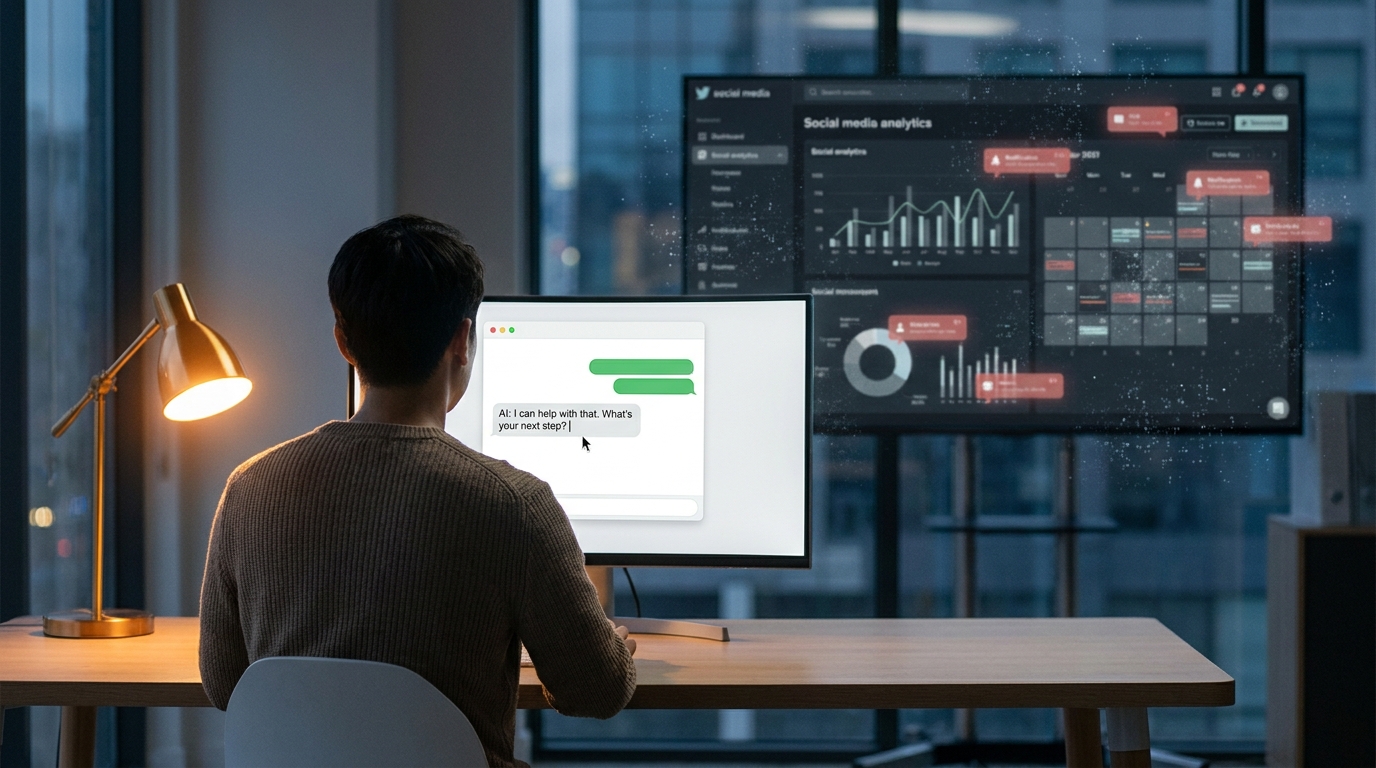
Something quiet is happening inside marketing teams right now.
Not a product launch. Not a platform update. Not a new feature from Meta or LinkedIn. It's a behavioral shift, and it's happening faster than anyone expected.
Marketers are stopping opening their dashboards.
Not because the dashboards broke. Not because the tools got worse. But because there's a faster, more natural way to get things done: they open Claude, say what they want, and the work happens.
"I haven't logged into our scheduling tool in three weeks," a content manager at a mid-sized DTC brand told us recently. "I just tell Claude what I need and it handles it."
She's not an edge case. She's the early signal.
The Dashboard Was Always a Compromise
Think about what a social media dashboard actually is.
It's an interface designed to bridge the gap between what you want to do, publish content, understand performance, stay consistent across platforms, and the underlying systems that make it happen. Dashboards are translators. They take complex API logic and wrap it in buttons, calendars, and dropdown menus so you don't have to think about the plumbing.
That translation layer was necessary when the alternative was writing code. But it came with real costs:
Cognitive overhead. Every tool has its own mental model. Where does the scheduling live? Which tab shows Instagram analytics? Why does the bulk upload format keep changing? You're not doing marketing anymore you're navigating software.
Context switching. Your strategy lives in Notion. Your drafts live in Google Docs. Your calendar lives in the scheduling tool. Your performance data lives in the analytics platform. You're the one manually stitching it all together, copy-pasting across five tabs, trying to hold the whole picture in your head.
Feature bloat. Every dashboard has accumulated years of features that most users never touch. The interface gets heavier. Onboarding gets longer. The thing that was supposed to save you time starts costing it.
Dashboards solved a real problem. But they created a new one: the tool itself became work.
What Changed: The Rise of the Conversational Interface
The assumption baked into every dashboard ever built is that humans need to navigate software to get things done. You click through menus. You fill out forms. You press buttons in the right order.
That assumption is now cracking.
Large language models, and Claude specifically, introduced something different: an interface where you describe what you want in plain language, and the system figures out the rest. No menus. No forms. No clicking through the right sequence of panels.
The shift is more profound than it looks. It's not just a new UI paradigm. It's a reversal of the relationship between the user and the tool.
With a dashboard, you learn the tool's logic and adapt to it.
With Claude, the tool adapts to yours.
This is why marketers who've started working through Claude sound almost confused when you ask them about their old workflow. "I just... don't think about it the same way anymore," is a phrase that comes up often. The friction they'd normalized for years suddenly became visible, and then optional.
The MCP Moment: When Claude Got Hands
For most of its early life, Claude was brilliant at thinking but couldn't do anything. It could write your post, refine your strategy, and analyze your last campaign, but it couldn't publish the post, schedule it, or pull the actual performance data. You still had to take the output and go do the thing yourself.
That changed with MCP — the Model Context Protocol — which lets Claude connect directly to external tools and services. Instead of Claude being a smart advisor you have to manually execute for, it becomes an agent that can act on your behalf.
For social media, this is the unlock.
Claude can now:
- Draft content informed by your actual brand voice and historical posts
- Schedule and publish across platforms without you touching a dashboard
- Pull real performance data and reason about what it means
- Suggest what to post next based on what's actually worked
This isn't a chatbot giving you ideas. This is an intelligent system completing the entire workflow — from strategy to publish — through a conversation.
RobinReach was built specifically to give Claude this capability for social media. It's an MCP server that connects Claude to your social accounts, your content history, and your analytics — so when you say "write and schedule three posts for this week based on what's been performing well," Claude doesn't just generate text. It does the work.
What This Actually Looks Like in Practice
Here's a real workflow that's replacing the dashboard for marketers who've made the switch:
Before (the dashboard era):
- Open analytics platform, pull last week's performance data
- Open Google Docs, write draft posts based on what you remember performing well
- Open scheduling tool, manually schedule each post
- Export report, paste into Slack update for the team
- Start over next week
Now (the conversational era):
"Look at what performed best this month, write three posts in a similar style for this week, and schedule them for our best engagement times."
That's the entire workflow. One sentence. Claude — with access to your data through RobinReach — handles the research, the drafting, the scheduling. You review, approve, and move on.
The dashboard didn't disappear because it became bad. It disappeared because the conversation became faster.
Why This Isn't Just About Convenience
It would be easy to frame this as a productivity story — same outputs, less time. But what's actually happening is more interesting.
When you remove the friction of navigating a tool, you change what's possible to think about.
Marketers who've adopted conversational workflows report that they're doing things they never did when dashboards were in the way. They're experimenting more because experimenting is cheap — a new content angle is one sentence, not a multi-step setup. They're iterating faster because the feedback loop is compressed. They're spending more time on strategy because execution is handled.
This is the hidden cost of dashboards nobody talks about: they didn't just take your time. They took your mental bandwidth. Every minute you spent navigating the tool was a minute you weren't thinking about the actual marketing.
Remove the tool. Think about the marketing.
The Objection You're Probably Having
"But I need to see everything. I need the calendar view, the analytics overview, the bulk scheduler."
This is the most common pushback, and it's worth addressing directly.
The assumption underneath it is that seeing things in a visual dashboard is inherently better than knowing about them through a conversation. But is that actually true, or is it just what you're used to?
When you open a dashboard and look at your scheduled posts for the week, you're checking that everything is in order. You could also just ask: "What do I have scheduled this week? Is there anything missing?" You get the same information. You just get it faster, in context, without navigating anywhere.
The calendar view is useful. But it's useful because it answers a question. Claude can answer that question too — and then immediately act on the answer, which the calendar can't.
The transition isn't about giving up information. It's about getting the same information without the overhead of the tool that was previously required to access it.
What the Dashboard Companies Should Be Worried About
The social media management software market is enormous — billions of dollars, dozens of major players, some of the most widely-used SaaS tools in marketing.
Every single one of them is built on the assumption that users need to navigate software to manage their social media presence.
That assumption is now in question.
The threat isn't that a new, better dashboard will steal their users. The threat is that the interface paradigm itself — the menu, the calendar, the analytics panel — becomes unnecessary overhead for a meaningful segment of users.
Historically, this kind of shift happens slowly and then suddenly. A small group of early adopters develops a new workflow. They talk about it. The workflow spreads. And then one day the incumbent wakes up to find that their user base has quietly developed a habit of not opening the product.
We are in the "slowly" phase right now. The "suddenly" is coming.
What Forward-Thinking Marketers Are Doing Today
The marketers getting ahead of this shift aren't waiting for their organizations to mandate a new tool. They're experimenting now, on their own, and building fluency before everyone else catches up.
Specifically:
- They're learning to work with Claude conversationally — not just using it to generate content, but using it as a thinking partner for strategy, analysis, and planning
- They're connecting Claude to their actual data via tools like RobinReach MCP, so the conversations are informed by real performance, real history, real brand context
- They're reclaiming the time they spent on tool navigation and reinvesting it in creative and strategic work
- They're building institutional knowledge in conversations, not in dashboards — because a well-prompted Claude session is searchable, shareable, and replicable in a way that "the way I use the tool" never was
The Bigger Picture
Every generation of marketing technology has followed the same arc: a new capability emerges, a layer of tooling gets built to make it accessible, the tooling becomes standard, the tooling becomes bloated, and then something simpler comes along and renders the tooling optional.
We built dashboards because we needed to manage social media at scale without writing code. We needed the translation layer.
Now we have a different kind of translation layer, one that speaks human. And when the interface is just language, the software in between starts to look like what it always was: a workaround.
The future of social media management isn't a better dashboard. It's not a cleaner calendar view or a smarter analytics panel or a more intuitive bulk scheduler.
The future is telling an AI what you want — in plain language, in a conversation, with full context of your brand and your data — and having the work happen in the background.
That future is already here for the marketers paying attention.
The dashboard era isn't ending with a bang. It's ending with a chat message.
RobinReach is an MCP server that connects Claude to your social media accounts, content history, and performance analytics — so you can manage your entire social media presence through a conversation. Learn more